
The Colosseum: Tickets, Prices, Hours and Skip-the-Line Tips
The Colosseum: Tickets, Prices, Hours and Skip-the-Line Tips
Contenidos de esta página sobre Roma
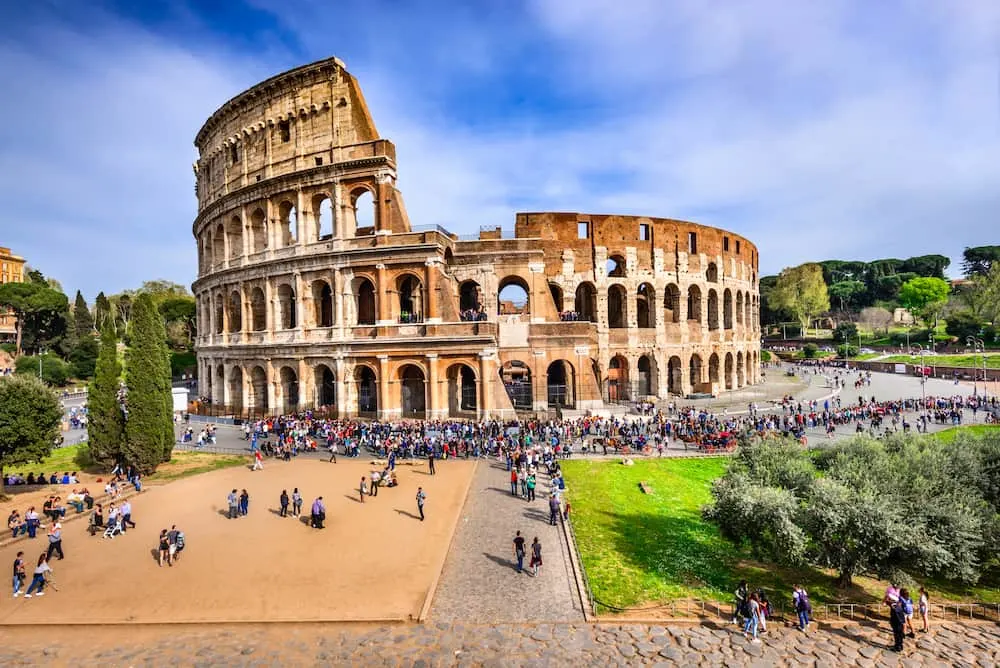
The Colosseum was the largest amphitheater in the Roman Empire and it is Rome's most famous symbol. For almost 500 years it was the epicenter of entertainment in Ancient Rome, used for public spectacles, gladiator fights, executions and even reenactments of naval battles.
Today it is one of the essential things to see in Rome and, along with the Trevi Fountain, one of the most visited monuments in the Italian capital.
The largest Roman amphitheater
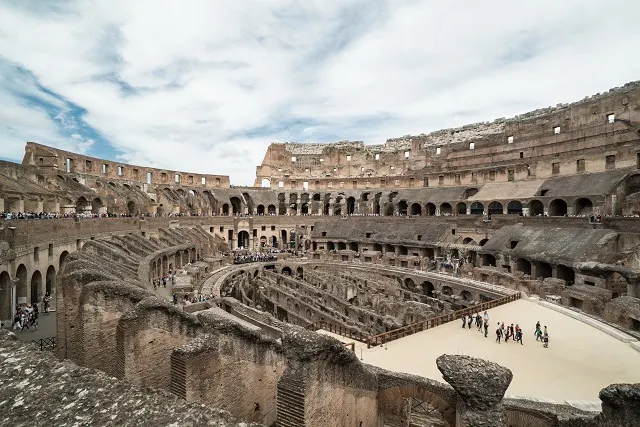
The Colosseum was the most monumental amphitheater ever built anywhere in the Roman Empire. Elliptical in shape, it measured 188 meters long, 156 meters wide and 48.5 meters high. The vast arena floor reached 75 x 44 meters.
With almost 2,000 years of history, it is one of the best preserved examples of Roman architecture around. A testament to the building genius of the Romans.
It was built by Emperor Vespasian around 70 AD under the Flavian dynasty, which is why it was originally called the «Flavian Amphitheater». Around the 8th century, though, the name «Colosseum» caught on, thanks to the striking bronze statue of the Colossus of Nero, 33.5 meters tall, that stood beside it and later disappeared.
It was inaugurated under Emperor Titus, in the 80s AD.
Parts of the Colosseum
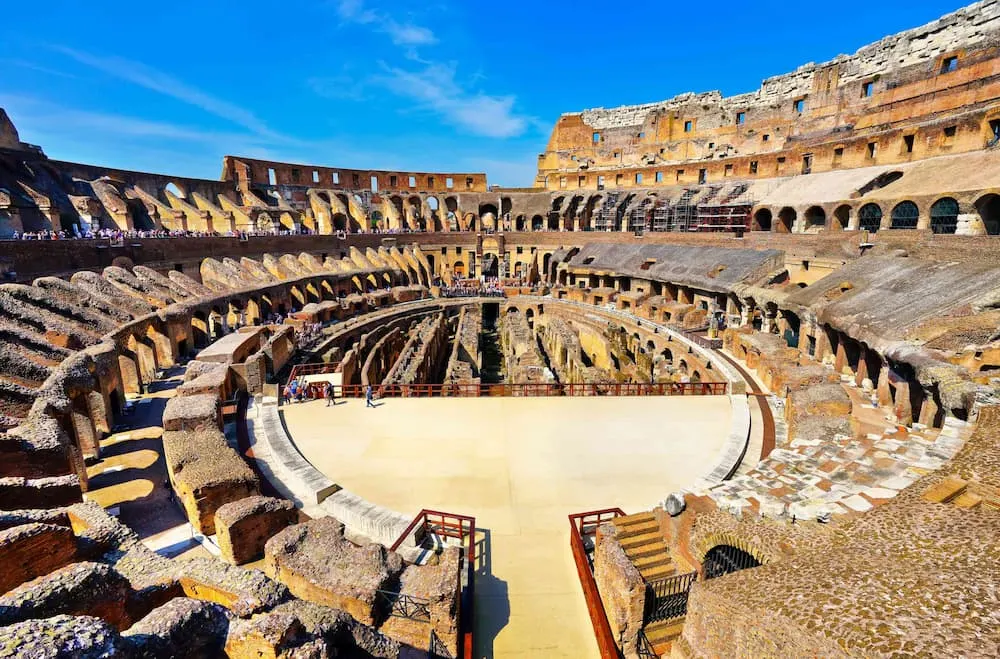
In its heyday, the Colosseum was made up of the following parts: the arena, the hypogeum, the cavea or seating tiers, the vomitoria and finally the velarium.
The Colosseum arena
The arena, or stage, was a platform of wood and sand where the spectacles took place. Its structure was fitted with all kinds of entrances, drains, hoists and trapdoors to keep the shows running smoothly.
Today you can visit the reconstructed section of the arena, where you can see the hoist that lifted both wild animals and gladiators to the surface. You can see it on a Colosseum tour with Arena access.
The hypogeum
The hypogeum refers to the underground structure beneath the arena, also known as the pit. It was a maze of dungeons, cells and tunnels where the gladiators got ready and the animals were kept before being brought up to the arena.
Colosseum tickets do not include the hypogeum, but you can see it on the underground Colosseum tour.
The cavea and vomitoria
The seating tiers, or cavea, was the area where the public sat, and where you sat depended strictly on your social standing. The podium, the lowest section, was reserved for senators, priests and magistrates, while the upper levels were for women, slaves and plebeians.
The vomitoria were the outer passageways that allowed the crowd to spread out and clear the building quickly.
The velarium
Finally, the velarium was a giant awning that shielded spectators from the sun and was unfurled using an elaborate system of pulleys. It no longer exists today.
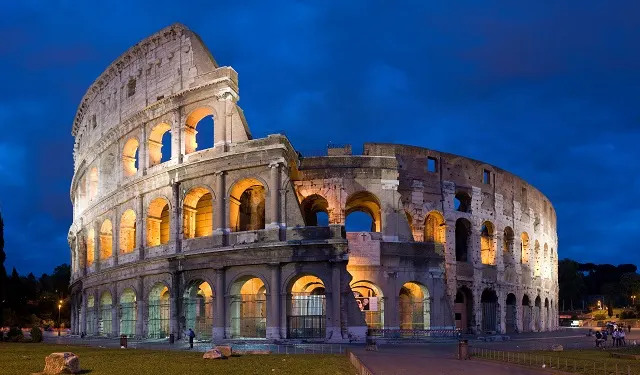
Originally there were special tickets with assigned seats, arranged starting with the highest class, seated closest to the arena. The lower classes, on the other hand, were placed right at the top. The higher up, the lower your place on the social ladder.
Worth noting: the topmost section was also for women, which says plenty about a woman's standing in Roman society.
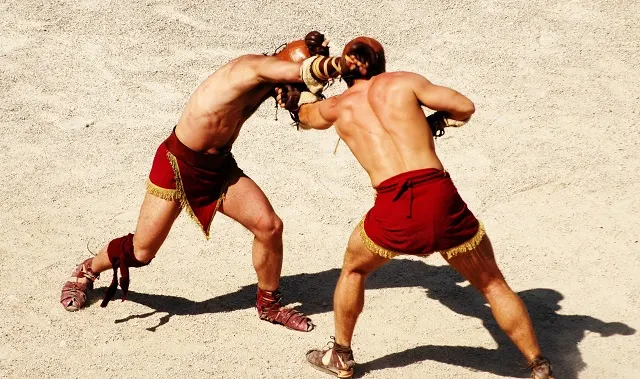
These days you'll come across friendly characters dressed as gladiators who will pose for photos with you and act out scenes from Ancient Rome. They're great fun!
Colosseum facts and curiosities
- The Colosseum is not circular, as many people think. It's elliptical! It measures 189 meters long, 156 meters wide and roughly 50 meters high, with an original capacity of between 50,000 and 65,000 spectators.
- In the year it was inaugurated, games were held that lasted 3 months. During that time, roughly more than 2,000 gladiators and 9,000 animals lost their lives.
- While Christians buried their dead in the Catacombs of Rome, there is no proof that Christians were devoured by wild beasts on Emperor Nero's orders, since he died in 68 AD, years before construction of the Colosseum began.
- Once those games ended, the Colosseum was used for all sorts of public events, theater performances, fights between gladiators and animals, and even executions.
- It was chosen as one of the 7 wonders of the modern world in the international contest run by the New Open World Corporation in 2007.
It goes without saying that the Colosseum is one of the monuments you simply can't miss, even if you're only seeing Rome in one day.
You can visit the Colosseum as a family and have a genuinely fun experience at this historic monument. It's an ideal activity if you're in Rome with kids.
Colosseum tickets
Since 2019 it has no longer been possible to buy Colosseum tickets at the box office, and given how high demand is, your best bet is to book in advance.
So what's the best way to get inside the Colosseum? There's a wide range of ticket types, which can be a bit confusing at first.
To help you find the ticket that best suits what you're after, take a look at our complete guide to Colosseum tickets. You'll find the clearest explanation of the different ticket types, prices and the advantages of each.
Before you head inside the Colosseum, a good way to get up to speed on its history is to book the free Imperial Rome walking tour, one of the most popular and best rated free tours in Rome.
Opening hours
- It opens at 8:30 am and closes at 4:30 pm in winter and at 7:15 pm in summer.
- It is closed on December 25, January 1, Good Friday and May 1.
How to get there
The Colosseum sits on Piazza del Colosseo, in the Celio neighborhood. It's easy to reach by metro, since it has its own station: Colosseo
Be sure to check out 5 cheap hotels near the Colosseum and stay as close as you can to this Roman monument. Some of them even have Colosseum views!